
Mine survey software
One site, six desk jobs,drafted for sign-off.
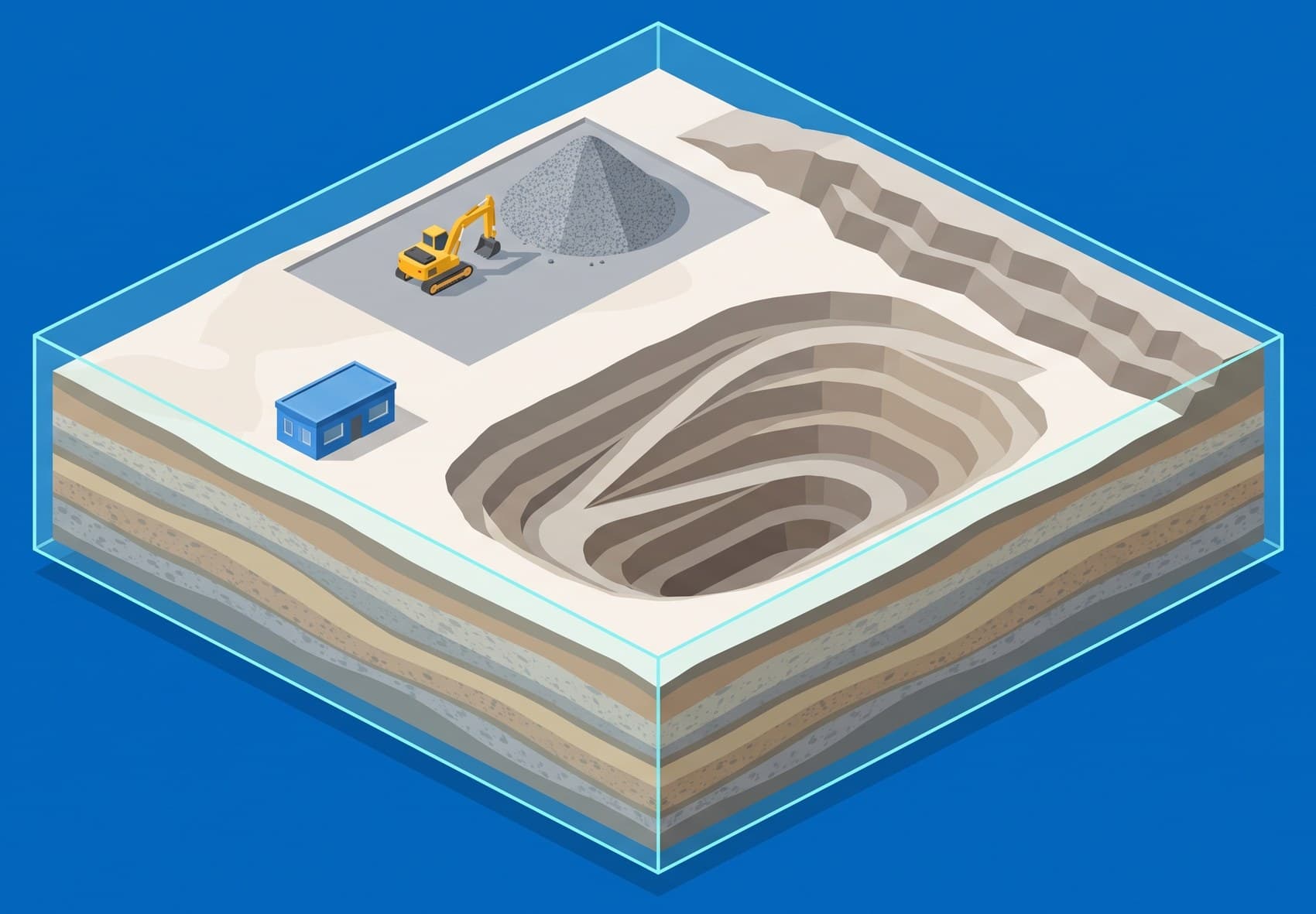
Pick a job on the Tarrant Hill diorama. The operator has read the survey export, the readings and the dispatch records, and drafted the move for a named person to sign.
ISO 27001 · GDPR · Every run auditable
1 · Stockpile reconciliation
SP-04 ROM pad, September
- Survey
- 88,752 t
- Book
- 92,410 t
- Gap
- −3,658 t
Explained 92,467 t, +57 t
Density 2.15 t/m³ updated to 2.24 t/m³. Drafted for J. Okafor, senior surveyor: the report and the register update.
Enterprises running operators on Alomana







Six jobs at one site, each ending with a person.The survey, the prisms and the dispatch system already produce the data. The operator does the checking and drafting that follows.
Stockpile reconciliation
Density outdated; report and register update drafted
Monitoring readings
Level 1 notice drafted for the geotechnical engineer
Sign-off pack
Pack assembled; one blank rating flagged
Shift losses
Three losses ranked with the dispatch log lines
Survey against plan
Deviation note drafted with the survey section
Historical records
Collars, depths and intervals extracted, each with its page
1 · SP-04 ROM pad, September
Illustrative reconciliation: the four checks
- Do the survey and the book cover the same period?Yes. The book closed 30 Sep 06:00; the survey was flown at 06:40.
- Does the survey boundary match the pad?Yes. Same polygon as the 1 Sep survey.
- Is every load in the book weighed?Yes. All 1,214 dispatch loads have a weighbridge ticket.
- Is the density current?No. The register uses 2.15 t/m³ from a 2024 test; the August lab test on SP-04 reads 2.24 t/m³.
Explained At 2.24 t/m³ the survey gives 92,467 t: 57 t from the book, inside the ±1,800 t tolerance.
How the operator works the month
Connect
Survey exports, monitoring spreadsheets and shift records in SharePoint, Drive or your database.
Check
It reconciles and compares in code, with the source of every number.
Sign off
You approve. It files the report and logs it.
Nothing is filed without a sign-off.
- Reports, notices and register updates wait for a person's yes
- A declined action is not retried
- Every run logged: input, output, tools, user
Run recordIllustrative reconciliation, SP-04 ROM pad
- Input
- Survey export (CSV), dispatch records, weighbridge tickets
- Tools
- Arithmetic and comparisons as code in an isolated sandbox
- Output
- Report and register update, drafted
- User
- J. Okafor, senior surveyor
Waits for sign-off
- Measured on
- Hours per survey cycle
- Days to close the month-end reconciliation
- Open monitoring actions
- Reports signed off on time
- Works with
- SharePoint
- Google Drive
- Google Sheets
- Snowflake
- PostgreSQL
- Slack
- Exports from your survey and geology software
- Trusted for
- ISO 27001
- GDPR
- Never trains on your data
- Single-tenant for enterprise
A custom operator typically goes live in up to 4 weeks.
Questions
What is stockpile reconciliation software?
Alomana is not a survey package. An operator reconciles the volume from your survey export against the book, with the source of every number, and drafts the report for your surveyor to sign off. Your drones, scanners and planning software keep capturing and modelling.
Is this mine survey software?
No. Your survey software keeps capturing and modelling. The operator works on what it exports (CSV and spreadsheet files and PDF reports) and does the checking and drafting that follows, for a person to approve.
Can it check monitoring readings against trigger levels?
Yes, on the readings you give it, when you run it. It compares them with your trigger levels and drafts the notice for your geotechnical engineer. It is not real-time monitoring; real-time alarms stay with your monitoring system.
What is an AI survey and monitoring operator?
An autonomous agent that does the desk work after the survey. It reads your survey exports, monitoring readings and shift records, reconciles volumes against the book, checks readings against your trigger levels, and drafts the report or notice for your surveyor or engineer to sign off.
Does it replace our survey or geology software?
No. Your drones, scanners, prisms and planning software keep capturing and modelling. The operator works on what they export: CSV and spreadsheet files and PDF reports, from SharePoint, Google Drive or your database.
Does it monitor the pit in real time?
No. It works on the readings and records you give it, when you run it, and drafts the follow-up for a person. Real-time alarms stay with your monitoring system.
Does it send or change anything on its own?
Filing a report, posting a notice or updating a register through Alomana's connectors waits for a person's yes. A declined action is not retried, and every run is logged with its input, output, tools and user.
Which systems does it connect to?
Alomana has 135 connectors, including SharePoint, Google Drive and Sheets, Snowflake, PostgreSQL and Slack, activated per deployment. Systems outside the library connect through a remote MCP server.
Is our site data private?
Alomana is ISO 27001 certified and GDPR-compliant, and your data is never used to train AI models. Enterprise deployments run single-tenant, in a dedicated instance.
Bring one month's survey export.
Talk it over with sales: what the operator needs from your systems, and how it goes live.
Alomana is a secure enterprise AI platform where autonomous agents, called operators, run business processes end to end. Every run is fully auditable.